Getting comfortable with Shield
Your guide to
Computer Shield.
Start normally, choose the monitoring you want, and use clear controls when something needs a closer look.
1. Open Shield and choose your settings
Install Shield from Microsoft Store and open it as your normal Windows user. The current dashboard opens directly. Network, fullscreen, personal-folder and remote-access monitoring are enabled by default; saved choices are preserved.
Use Settings in the dashboard header or More options → Monitoring settings to choose what runs. Optional external reputation downloads are off by default. You can select which personal folders to monitor.
Keep Shield open or in the tray for monitoring. Closing its window can hide it to the tray; use Exit in its tray menu to stop it. No administrator launch or firewall change is needed.
Get it on Microsoft Store2. Understand the status display
- Green
- Network collection is responsive. This is a collector-health signal, not a safety verdict.
- Amber
- A recent security observation needs review, or collection/feed coverage is limited. Open Monitoring details and Recent alerts.
- Gray
- Monitoring is off, paused or starting. Check your settings if that was not intended.
Check network activity opens a timed observation window. It does not certify your network as clean. Counts of many destinations are retained quietly; volume alone is not treated as an attack.
The companion connection
3. Add ArRENCE Browser
Shield works on its own. Connecting ArRENCE adds page-level warning signals and controls scoped to the observed tab.
Copy your code in Shield
Open both apps. In Shield, choose Connect Arrence Browser, then Copy code. A code lasts two minutes; Get a new code is right beside it.
Connect in Browser
In ArRENCE Browser, open Settings → Webb Computer Shield. Paste the code and choose Connect and enable page checks. Confirm the intended Shield app if asked.
You’re connected
The current installed apps verify each other and finish automatically. Look for Shield: Connected in Browser. Keep both apps open or running in the tray while you browse.
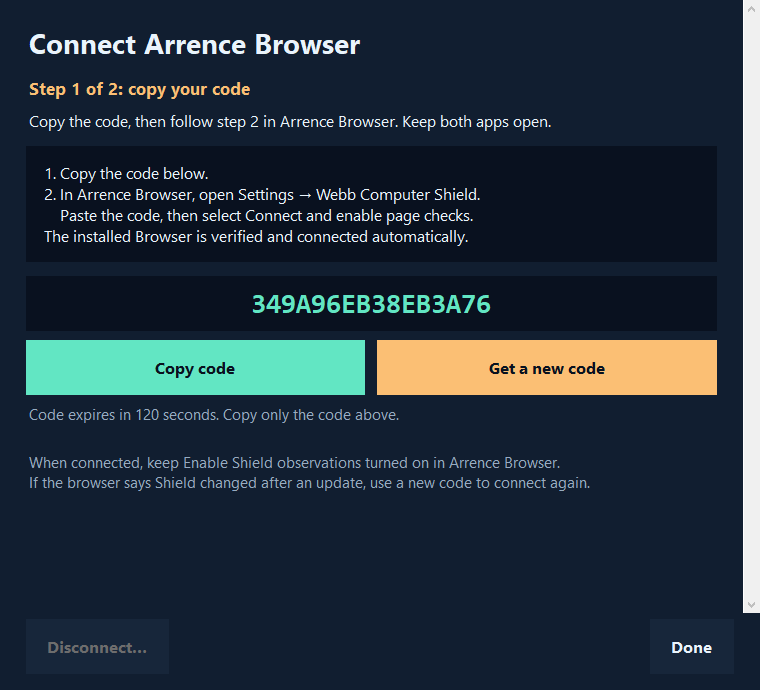
Keep Enable Shield observations turned on in Browser. Private-session checks are a separate choice and are off by default. After either app updates, a fresh code may be needed.
Learn about ArRENCE Browser ↗4. Review first, then choose an action
Open Recent alerts to inspect an observation. A fullscreen window, remote-capable program or reputation match alone is not proof of malware. Shield does not automatically kill programs or remove files.
If a warning pressures you to call a number, pay immediately or allow remote access, pause. Use Exit a full-screen window, or Ctrl + Alt + F12 when available, to reach escape controls. With Browser connected, supported actions target the observed tab.
You can pause fullscreen notifications for 15 minutes from More options. This changes notifications; the other collectors continue. Only authorize a remote-tool exception if you recognize and intended that connection.
5. Use encrypted file recovery carefully
The quarantine vault uses Windows user-scoped encryption. It holds files you explicitly move there and provides restore or permanent-delete controls for the selected record. Restore needed files before uninstalling or resetting the app, because package data may be removed.
Recovery requires the original Windows user’s encryption credentials/profile. Keep independent backups of important files. Older quarantine records are preserved for the recovery workflow; they are not silently replaced.
What Shield can—and can’t—see
Browser checks use visible-text patterns, mainly English. Native desktop text/OCR checks depend on what Windows can expose and may miss image-only, protected or unusual content. Network checks may miss short-lived connections; optional existing Sysmon telemetry can improve coverage. File-change signals do not identify a writer or prove ransomware.
Keep your antivirus, Windows protections and backups in place. Shield adds observations and controls alongside them.
Help with a problem or bug report ↗